https://www.youtube.com/watch?v=KzV_UCQFY6w
Feliz Navidad to all !
a home made parody:
https://www.youtube.com/watch?v=cA0xU2Tdxzs
xx
And this is great as well:
https://www.youtube.com/watch?v=nfzreHfRx-s
Wednesday, December 14, 2016

Friday, December 9, 2016
record part 2
https://madmimi.com/p/2db239


Yesterday, we began exploring a few mindset tweaks to help us overcome our aversion to recording ourselves. The main one being, it helps to approach recording as a diagnostic tool, instead of as an evaluative tool (you can read it here, if you missed it).
Today, we’ll look at how recording can be an essential tool in preparing us for the mental rigors of a performance. To make it easier to get into the "zone" and avoid worrying about memory slips, what the audience might be thinking, dwelling on mistakes, and getting sucked into that downward vortex of doom.
And believe it or not, when you utilize recording in this way, you may find it hard notto listen back to yourself.
How so?
Creating vs. analyzing
There’s a saying, popularized by John Cage, which originally came from a list of 10 “rules” for students and teachers in a college art department. It goes: “Don’t try to create and analyze at the same time. They’re different processes.”
There is mounting evidence in overlapping areas of research which suggest that there is quite a bit of truth to be found in this statement. Specifically, that we tend to perform best when we are completely immersed in the task at hand, rooted firmly in the present, and focused on creating each moment as it’s happening. And that we perform worse when we worry about what’s coming up, or judge, analyze, and react to every little intonation glitch, cracked note, or rhythmic imperfection as it happens.
The problem of course, is that we are really, really good at judging, analyzing, and reacting. So it’s understandably tough to shut all that stuff off on cue.
Why so difficult?
Because we practice judging, analyzing, and reacting every day.
The "self-monitor"
After all, one of the determinants of effective practice is our ability to self-monitor our playing. To develop a keen ear capable of catching the slightest imperfection, so we can stop, backtrack, and make it better.
So day by day, as we engage in deliberate practice and hone our self-monitoring skills, our ears become ever more finely tuned, and we become quite good at this skill.
Which is great news when it comes to maximizing our progress in the practice room. Unfortunately, this skill is like kryptonite for us on stage, as it totally sabotages our ability to play freely, create spontaneous moments of awesomeness, and enjoy the experience of performing for others.
So in that sense, practicing effectively and performing optimally are two very different skills. In much the same way that we have to be diligent in maintaining an optimal practice mindset, we have to practice developing an optimal performance mindset too.
How, exactly?
Ah, yes. Recording!
Turning off the self-monitor
I think this is one of the most important uses of a recording device. Not to evaluate or diagnose the biggest issues in our playing, but to give us an opportunity to practice turning off the self-monitor while playing, so we can work on the mental aspect of performing.
To delegate the task of listening to the recording device, so we can see what happens when we devote our cognitive resources to creating music. To shaping a line just so. Or staying connected to an underlying rhythmic framework or pulse.
Where we are focused on making music, not analyzing and keeping score of all our misses.
Action step for today
So that’s today’s action step.
Take a moment to record yourself as you did yesterday - but this time, make it your #1 goal to turn off the self-monitor as you play. To instead focus on sound, phrasing, imagery, or whatever it is that you intend to think about when performing.
You might find this to be more challenging than it sounds! And the price of success is that you may have only a vague sense of how it went, with little memory of what specific areas need work. Doesn't that make you curious to hear what you sounded like?
Which is where the recording comes into play. Now is the time to analyze and diagnose (but not evaluate!) to your heart’s content. Not when you’re performing (or doing a “trial” or “mock” performance).
Yesterday, we began exploring a few mindset tweaks to help us overcome our aversion to recording ourselves. The main one being, it helps to approach recording as a diagnostic tool, instead of as an evaluative tool (you can read it here, if you missed it).
Today, we’ll look at how recording can be an essential tool in preparing us for the mental rigors of a performance. To make it easier to get into the "zone" and avoid worrying about memory slips, what the audience might be thinking, dwelling on mistakes, and getting sucked into that downward vortex of doom.
And believe it or not, when you utilize recording in this way, you may find it hard notto listen back to yourself.
How so?
Creating vs. analyzing
There’s a saying, popularized by John Cage, which originally came from a list of 10 “rules” for students and teachers in a college art department. It goes: “Don’t try to create and analyze at the same time. They’re different processes.”
There is mounting evidence in overlapping areas of research which suggest that there is quite a bit of truth to be found in this statement. Specifically, that we tend to perform best when we are completely immersed in the task at hand, rooted firmly in the present, and focused on creating each moment as it’s happening. And that we perform worse when we worry about what’s coming up, or judge, analyze, and react to every little intonation glitch, cracked note, or rhythmic imperfection as it happens.
The problem of course, is that we are really, really good at judging, analyzing, and reacting. So it’s understandably tough to shut all that stuff off on cue.
Why so difficult?
Because we practice judging, analyzing, and reacting every day.
The "self-monitor"
After all, one of the determinants of effective practice is our ability to self-monitor our playing. To develop a keen ear capable of catching the slightest imperfection, so we can stop, backtrack, and make it better.
So day by day, as we engage in deliberate practice and hone our self-monitoring skills, our ears become ever more finely tuned, and we become quite good at this skill.
Which is great news when it comes to maximizing our progress in the practice room. Unfortunately, this skill is like kryptonite for us on stage, as it totally sabotages our ability to play freely, create spontaneous moments of awesomeness, and enjoy the experience of performing for others.
So in that sense, practicing effectively and performing optimally are two very different skills. In much the same way that we have to be diligent in maintaining an optimal practice mindset, we have to practice developing an optimal performance mindset too.
How, exactly?
Ah, yes. Recording!
Turning off the self-monitor
I think this is one of the most important uses of a recording device. Not to evaluate or diagnose the biggest issues in our playing, but to give us an opportunity to practice turning off the self-monitor while playing, so we can work on the mental aspect of performing.
To delegate the task of listening to the recording device, so we can see what happens when we devote our cognitive resources to creating music. To shaping a line just so. Or staying connected to an underlying rhythmic framework or pulse.
Where we are focused on making music, not analyzing and keeping score of all our misses.
Action step for today
So that’s today’s action step.
Take a moment to record yourself as you did yesterday - but this time, make it your #1 goal to turn off the self-monitor as you play. To instead focus on sound, phrasing, imagery, or whatever it is that you intend to think about when performing.
You might find this to be more challenging than it sounds! And the price of success is that you may have only a vague sense of how it went, with little memory of what specific areas need work. Doesn't that make you curious to hear what you sounded like?
Which is where the recording comes into play. Now is the time to analyze and diagnose (but not evaluate!) to your heart’s content. Not when you’re performing (or doing a “trial” or “mock” performance).
The 5-sentence summary
So to sum up, your self-monitor is your best friend when you’re practicing. And your worst enemy when performing.
So in order to get better at “performance mode,” you’ll have to practice turning the self-monitor off from time to time. Of course, with self-monitor taking a break, you won’t have as clear a bead on how you sound. Hence the need for a recording device to make sure you’re playing in a way that accurately represents what you’re aiming for when self-monitor is turned off.
What’s next?
Today’s exercise is an example of “performance practice.” A type of practice that is geared towards “pressure-proofing” our skills and ensuring that we are able to transfer what we sound like in the practice room, to the stage.
Of course, this can sometimes feel like an impossible challenge. I get emails every day from musicians who are frustrated by trembling hands. Fear of memory slips. Panic that sets in and totally immobilizes their body as they fumble through the performance. A history of coming close, but falling ever so short in auditions.
But above all, many describe a sense that they are doing everything they know to do, yet things remain the same.
I think we’ve all been there at one point or another. But if I’ve learned nothing else in the last 20 years, it’s that we don’t have to resign ourselves to this. In the same way that learning how to swim changes your experience of being in the deep end of a pool, there are specific, concrete skills we can learn that change our experience of performing.
The art and science of peak performance
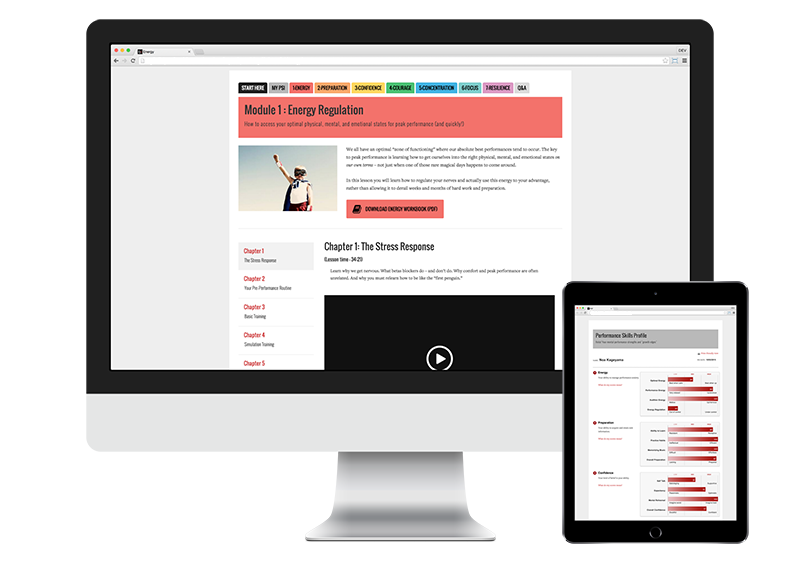
Beyond Practicing is the online version of the courses I teach at Juilliard. It’s not a brain dump of abstract theory, but a structured, organized system that will teach you how to develop the skills you need to perform your best when it counts. Seven, to be exact.
You’ll start out with an 84-question mental skills assessment that will identify your strengths and weaknesses and pinpoint exactly what is holding you back from performing up to your full abilities. And then dive into a series of lessons that will help you develop the 7 mental skills that are associated with high-level performance.
The course includes:
▪ 9+ hours of video presentations, audio, and full transcripts with worksheets, step-by-step exercises, and drills. The videos will work on your computer, tablet, or smartphone - pretty much anywhere you can get internet access (and there’s an option for offline access too).
▪ Lifetime access. So you don't have to deal with monthly membership fees or feel like you need to rush through things. You can use the training now...or later...and refer back to it as a resource anytime you like.
▪ A 60-day 100% money-back guarantee. I believe strongly in the value of these skills - but I want you to feel the same. So it’s important to me that you have some time to see if it’s a good fit.
A special holiday 2-for-1 offer
And from FRIDAY (12/9) at 12:01am until SUNDAY (12/11) midnight(Pacific), Beyond Practicing is available at 2-for-1 pricing. Meaning, when you sign up, I will create a second account at no additional cost that you can gift to a “training buddy" of your choice. Because while having a friend or colleague (or student) to work through the course with is totally optional, it can deepen the learning process, not to mention the fun.
Over 2500 musicians have taken the course, ranging from professional orchestral and ensemble players, to university professors, talented teens, serious amateurs, and adult learners. Many have written in, sharing news of auditions or competitions they have won, or performances which represent personal highlights. Like the mother of a serious middle school-aged string player who used the course to successfully prepare for a high-profile radio performance. Or the trial attorney who worked through the course in preparation for a recital, in which he experienced a peak performance for the first time. Or an adult learner whose teacher signed up for the course after seeing how much of an impact it made.
But the feedback that I find most meaningful centers around how differently they feel about performing and auditioning. How it feels like they now have tools they can rely on. And how performances once felt out of their control, but they now feel they can play in a way that represents their true abilities.
That was my experience too when I first discovered performance psychology. And if you haven’t experienced this yet yourself, I’d like to help you get there.
-Noa
P.S. I’m betting you’ve had some performances where everything clicked - yet you weren’t sure why or how that happened. Don't worry; it wasn't an accident. Beyond Practicing is about identifying these key factors, and developing them into core strengths, so that you can do this on stage more consistently.
Remember, the 2-for-1 offer ends this Sunday (12/11) at 11:59pm Pacific time. Click the button below to learn more about the course and the holiday offer.
So to sum up, your self-monitor is your best friend when you’re practicing. And your worst enemy when performing.
So in order to get better at “performance mode,” you’ll have to practice turning the self-monitor off from time to time. Of course, with self-monitor taking a break, you won’t have as clear a bead on how you sound. Hence the need for a recording device to make sure you’re playing in a way that accurately represents what you’re aiming for when self-monitor is turned off.
What’s next?
Today’s exercise is an example of “performance practice.” A type of practice that is geared towards “pressure-proofing” our skills and ensuring that we are able to transfer what we sound like in the practice room, to the stage.
Of course, this can sometimes feel like an impossible challenge. I get emails every day from musicians who are frustrated by trembling hands. Fear of memory slips. Panic that sets in and totally immobilizes their body as they fumble through the performance. A history of coming close, but falling ever so short in auditions.
But above all, many describe a sense that they are doing everything they know to do, yet things remain the same.
I think we’ve all been there at one point or another. But if I’ve learned nothing else in the last 20 years, it’s that we don’t have to resign ourselves to this. In the same way that learning how to swim changes your experience of being in the deep end of a pool, there are specific, concrete skills we can learn that change our experience of performing.
The art and science of peak performance
Beyond Practicing is the online version of the courses I teach at Juilliard. It’s not a brain dump of abstract theory, but a structured, organized system that will teach you how to develop the skills you need to perform your best when it counts. Seven, to be exact.
You’ll start out with an 84-question mental skills assessment that will identify your strengths and weaknesses and pinpoint exactly what is holding you back from performing up to your full abilities. And then dive into a series of lessons that will help you develop the 7 mental skills that are associated with high-level performance.
The course includes:
▪ 9+ hours of video presentations, audio, and full transcripts with worksheets, step-by-step exercises, and drills. The videos will work on your computer, tablet, or smartphone - pretty much anywhere you can get internet access (and there’s an option for offline access too).
▪ Lifetime access. So you don't have to deal with monthly membership fees or feel like you need to rush through things. You can use the training now...or later...and refer back to it as a resource anytime you like.
▪ A 60-day 100% money-back guarantee. I believe strongly in the value of these skills - but I want you to feel the same. So it’s important to me that you have some time to see if it’s a good fit.
A special holiday 2-for-1 offer
And from FRIDAY (12/9) at 12:01am until SUNDAY (12/11) midnight(Pacific), Beyond Practicing is available at 2-for-1 pricing. Meaning, when you sign up, I will create a second account at no additional cost that you can gift to a “training buddy" of your choice. Because while having a friend or colleague (or student) to work through the course with is totally optional, it can deepen the learning process, not to mention the fun.
Over 2500 musicians have taken the course, ranging from professional orchestral and ensemble players, to university professors, talented teens, serious amateurs, and adult learners. Many have written in, sharing news of auditions or competitions they have won, or performances which represent personal highlights. Like the mother of a serious middle school-aged string player who used the course to successfully prepare for a high-profile radio performance. Or the trial attorney who worked through the course in preparation for a recital, in which he experienced a peak performance for the first time. Or an adult learner whose teacher signed up for the course after seeing how much of an impact it made.
But the feedback that I find most meaningful centers around how differently they feel about performing and auditioning. How it feels like they now have tools they can rely on. And how performances once felt out of their control, but they now feel they can play in a way that represents their true abilities.
That was my experience too when I first discovered performance psychology. And if you haven’t experienced this yet yourself, I’d like to help you get there.
-Noa
P.S. I’m betting you’ve had some performances where everything clicked - yet you weren’t sure why or how that happened. Don't worry; it wasn't an accident. Beyond Practicing is about identifying these key factors, and developing them into core strengths, so that you can do this on stage more consistently.
Remember, the 2-for-1 offer ends this Sunday (12/11) at 11:59pm Pacific time. Click the button below to learn more about the course and the holiday offer.
Thursday, December 8, 2016
record yourself
Not for "boosting your ego".
https://madmimi.com/p/d5f039
Winter recitals. Pre-screening tapes for conservatory auditions. Then competitions, juries, orchestral auditions, and more. Aaagh!
The holiday break gives us a moment to catch our breaths from school or work, but we also know that there is a lot of practicing to be done in the months ahead. And, that one of our crucial challenges will be finding ways to make the most of our limited time and energy, so we can polish our rep to a performance-ready state that we feel good about.
Yet why do we avoid the one strategy that could turn our practice efficiency, level of playing, and confidence up to 11?
Umm…what strategy might that be?
Recording!
Ugh…
https://madmimi.com/p/d5f039
Winter recitals. Pre-screening tapes for conservatory auditions. Then competitions, juries, orchestral auditions, and more. Aaagh!
The holiday break gives us a moment to catch our breaths from school or work, but we also know that there is a lot of practicing to be done in the months ahead. And, that one of our crucial challenges will be finding ways to make the most of our limited time and energy, so we can polish our rep to a performance-ready state that we feel good about.
Yet why do we avoid the one strategy that could turn our practice efficiency, level of playing, and confidence up to 11?
Umm…what strategy might that be?
Recording!
Ugh…
Wednesday, December 7, 2016
ukulele magazine
you can subscribe, but there are many free things as well:
Free downloads (common chords, lessons, how to's):
http://store.ukulelemag.com/collections/free-downloads
Process the item as if you were purchasing it - this store does not require a credit card or payment information, for free items! Nice. You will get an email with the link to download.
Suggestions on how to make your video look good:
http://www.ukulelemag.com/stories/uketube-diy-5-ways-to-make-your-best-ukulele-video-yet
Free downloads (common chords, lessons, how to's):
http://store.ukulelemag.com/collections/free-downloads
Process the item as if you were purchasing it - this store does not require a credit card or payment information, for free items! Nice. You will get an email with the link to download.
Suggestions on how to make your video look good:
http://www.ukulelemag.com/stories/uketube-diy-5-ways-to-make-your-best-ukulele-video-yet
Sunday, November 20, 2016
Winchester Farmers Market 2016 Nov 19th
"WebDVD" http://ourigami.com/2016novwfm/ (sorry this does not play on phones/mobile - use a computer)
For phones and tablets: playlist on YouTube:
https://www.youtube.com/playlist?list=PL7ocrE0tlpoCh1PNLE5H0NnvdvPHgpQK1
xx
Winchester Farmsers Market - will be back next year - sign up for news, updates, and events at:
http://www.winchesterfarmersmarket.org/
For phones and tablets: playlist on YouTube:
https://www.youtube.com/playlist?list=PL7ocrE0tlpoCh1PNLE5H0NnvdvPHgpQK1
xx
Winchester Farmsers Market - will be back next year - sign up for news, updates, and events at:
http://www.winchesterfarmersmarket.org/
Sunday, October 30, 2016
mentioned in Boston Globe
http://www.bostonglobe.com/lifestyle/real-estate/2016/10/28/locationweb/mP8uGkXdbMdsVYBxKDLLiM/story.html?s_campaign=email_BG_TodaysHeadline&s_campaign=
What is it like to live in Winchester?

JOANNE RATHE/GLOBE STAFF
A barn at Wright-Locke Farm in Winchester.
By Rachel Lebeaux GLOBE CORRESPONDENT OCTOBER 28, 2016
Susan Barrett has music in her heart and has dedicated her life’s work to sharing it.
Barrett and her husband, Edward, moved to Winchester in 1971. “We bought a home on Manomet Road, our first little house,” she said. They raised two sons in Winchester.
Barrett taught music for many years in Burlington before joining the Winchester public schools’ music department in the late 1970s. In 1980, she left to teach private piano lessons when her second child was born, instructing hundreds of burgeoning area musicians until her retirement this year. A large party was thrown in her honor, with many longtime former students in attendance.
That kind of gathering is indicative of the close-knit, supportive character of this affluent bedroom community, according to Barrett. “I like that close feeling of the town. I have lived in Winchester from the time that I was a young mother to the time that I am a grandmother. I still feel that the town and its spirit and friendliness are the same,” she said.
Barrett hasn’t stopped spreading music in the community. A few years ago, she picked up the ukulele at the senior center and joined a group called Shukulele. “We have a great time and hopefully bring smiles to a bunch of people,” she said. “I’ve been really active in taking advantage of offerings in the community and hopefully giving something of myself back, too.”
What is it like to live in Winchester?
JOANNE RATHE/GLOBE STAFF
A barn at Wright-Locke Farm in Winchester.
By Rachel Lebeaux GLOBE CORRESPONDENT OCTOBER 28, 2016
Susan Barrett has music in her heart and has dedicated her life’s work to sharing it.
Barrett and her husband, Edward, moved to Winchester in 1971. “We bought a home on Manomet Road, our first little house,” she said. They raised two sons in Winchester.
Barrett taught music for many years in Burlington before joining the Winchester public schools’ music department in the late 1970s. In 1980, she left to teach private piano lessons when her second child was born, instructing hundreds of burgeoning area musicians until her retirement this year. A large party was thrown in her honor, with many longtime former students in attendance.
That kind of gathering is indicative of the close-knit, supportive character of this affluent bedroom community, according to Barrett. “I like that close feeling of the town. I have lived in Winchester from the time that I was a young mother to the time that I am a grandmother. I still feel that the town and its spirit and friendliness are the same,” she said.
Barrett hasn’t stopped spreading music in the community. A few years ago, she picked up the ukulele at the senior center and joined a group called Shukulele. “We have a great time and hopefully bring smiles to a bunch of people,” she said. “I’ve been really active in taking advantage of offerings in the community and hopefully giving something of myself back, too.”
Monday, October 10, 2016
Subscribe to:
Posts (Atom)