Another piece of the science that demonstrates the benefit of music: --------------from the article----------- Want to 'train your brain'? Forget apps, learn a musical instrument
Musical training can have a dramatic impact on your brain’s structure, enhancing your memory, spatial reasoning and language skills
Mo Costandi@mocost Mon 24 Oct 2016 05.03 EDTLast modified on Mon 24 Jul 2017 10.04 EDT ‘Music probably does something unique. It stimulates the brain in a very powerful way, because of our emotional connection with it.’ Illustration: Sophie Wolfson
The multimillion dollar brain training industry is under attack. In October 2014, a group of over 100 eminent neuroscientists and psychologists wrote an open letter warning that “claims promoting brain games are frequently exaggerated and at times misleading”. Earlier this year, industry giant Lumosity was fined $2m, and ordered to refund thousands of customers who were duped by false claims that the company’s products improve general mental abilities and slow the progression of age-related decline in mental abilities. And a recent reviewexamining studies purporting to show the benefits of such products found “little evidence ... that training improves improves everyday cognitive performance”.
While brain training games and apps may not live up to their hype, it is well established that certain other activities and lifestyle choices can have neurological benefits that promote overall brain health and may help to keep the mind sharp as we get older. One of these is musical training. Research shows that learning to play a musical instrument is beneficial for children and adults alike, and may even be helpful to patients recovering from brain injuries.
“Music probably does something unique,” explains neuropsychologist Catherine Loveday of the University of Westminster. “It stimulates the brain in a very powerful way, because of our emotional connection with it.”
Playing a musical instrument is a rich and complex experience that involves integrating information from the senses of vision, hearing, and touch, as well as fine movements, and learning to do so can induce long-lasting changes in the brain. Professional musicians are highly skilled performers who spend years training, and they provide a natural laboratory in which neuroscientists can study how such changes – referred to as experience-dependent plasticity– occur across their lifespan.
Early brain scanning studies revealed significant differences in brain structure between musicians and non-musicians of the same age. For example, the corpus callosum, a massive bundle of nerve fibres connecting the two sides of the brain, is significantly larger in musicians. The brain areas involved in movement, hearing, and visuo-spatial abilities also appear to be larger in professional keyboard players. And, the area devoted to processing touch sensations from the left hand is increased in violinists.
These studies compared data from different groups of people at one point in time. As such, they could not determine whether the observed differences were actually caused by musical training, or if existing anatomical differences predispose some to become musicians. But later, longitudinal studies that track people over time have shown that young children who do 14 months of musical training exhibit significant structural (pdf) and functional brain changes (pdf) compared to those who do not.
Together, these studies show that learning to play a musical instrument not only increases grey matter volume in various brain regions, but can also strengthen the long-range connections between them. Other research shows that musical training also enhances verbal memory, spatial reasoning, and literacy skills, such that professional musicians usually outperform non-musicians on these abilities. Long-lasting benefits for musicians
Importantly, the brain scanning studies show that the extent of anatomical change in musicians’ brains is closely related to the age at which musical training began, and the intensity of training. Those who started training at the youngest age showed the largest changes when compared to non-musicians.
Music reaches parts of the brain that other things can’tCatherine Loveday, University of Westminster
Even short periods of musical training in early childhood can have long-lasting benefits. In one 2013 study, for example, researchers recruited 44 older adults and divided them into three groups based on the level of formal musical training they had received as children. Participants in one group had received no training at all; those in the second had done a little training, defined as between one and three years of lessons; and those in the third had received moderate levels of training (four to 14 years).
The researchers played recordings of complex speech sounds to the participants, and used scalp electrodes to measure the timing of neural responses in a part of the auditory brainstem. As we age, the precision of this timing deteriorates, making it difficult to understand speech, especially in environments with a lot of background noise. Participants who had received moderate amounts of musical training exhibited the fastest neural responses, suggesting that even limited training in childhood can preserve sharp processing of speech sounds and increase resilience to age-related decline in hearing.
Unlike commercial brain training products, which only improve performance on the skills involved, musical training has what psychologists refer to as transfer effects – in other words, learning to play a musical instrument seems to have a far broader effect on the brain and mental function, and improves other abilities that are seemingly unrelated.
“Music reaches parts of the brain that other things can’t,” says Loveday. “It’s a strong cognitive stimulus that grows the brain in a way that nothing else does, and the evidence that musical training enhances things like working memory and language is very robust.”
Learning to play a musical instrument, then, seems to be one of the most effective forms of brain training there is. Musical training can induce various structural and functional changes in the brain, depending on which instrument is being learned, and the intensity of the training regime. It’s an example of how dramatically life-long experience can alter the brain so that it becomes adapted to the idiosyncrasies of its owner’s lifestyle.
If you want to learn a musical instrument or have been struggling to make progress on your current instrument, this article should be very helpful for you.
Learning how to play any musical instrument is a process that takes time and no matter how much you practice - you have to work at managing your mindset.
Knowing how to manage your mindset and emotions will save you time and stress when you are feeling overwhelmed, as everyone who decides to learn music goes through both positive and negative emotions.
The goal of this article is to help you be more prepared when negative emotions come your way...
If you follow my points closely, you'll have a much better chance of limiting your discouragement and preventing the ultimate disappointment of quitting the instrument that at one point or other (hopefully still), you wanted so badly to learn and master.
Starting Music and the Importance of Mindset
Most people who have interest in learning a musical instrument have one thing in common...
They are extremely excited and emotional about the thought of being able to play!
Maybe you are a parent who loves the thought of your child being exceptional at music - or an adult who loves the thought of developing a new hobby...
No matter what your situation, you can probably envision all the fun and reward you would get out of playing music well, and reaching the point of no return.
So why do so many students and parents have the passion for wanting to learn music but only a percentage actually stick with it?
The answer to that question in most instances is not because of their lack of talent...or age...or lack of time (I've heard many excuses).
Reading between the lines, the most common reason I see comes down to the person's mindset, and how the brain evaluates progress.
This doesn't just happen with students...
I've seen many mindset mistakes with parents as they can prematurely evaluate the progress of their child (commonly related to their child's dedication/commitment level).
If my mom would have critically evaluated my commitment level at age 13, I would not be a teacher today and have an entire business dedicated to teaching people violin...let's just say I went through a stage where I loved sports a little more than music. :)
Unfortunately most beginners of all ages have no idea how to properly evaluate themselves and commonly let emotions get the best of them.
Thinking back to a sample set of violin students - about 9/10 of them had a negative outlook on how they play, compared to the 1/10 that thought they were doing much better than they actually were. :)
Tip: Having a private teacher is helpful because the teacher can help manage emotions and give the student a clear picture of how they are actually doing. A good teacher will not only show what you are doing wrong, but also encourage you to see progress from a healthier perspective. If you don't have access to a teacher, the next best thing is being a part of a learning group of some kind. Here is a Facebook group we manage of mostly adult learners with interest in learning violin. The group is highly encouraging and can definitely help keep your spirits up. You'll find us teachers here at Superior Violins doing our best to interact with the group and answer any questions they might have.
Evaluating Progress in 6 Month Increments
Unfortunately, our brains are quick to judge musical ability (too much American Idol on TV).
Here's the thing...even if you are right that you don't sound good at this point in time - you might have a healthier perspective if you only evaluated yourself based on how you were doing 6 months ago.
I like to refer to this as blocking the mind for 6. :)
This is what I ask my private students if they expressed concern for their progress on any shorter-term level...
"Wouldn't you say you sound a lot better today than you did 6 months ago? Maybe that song that gave you so much trouble during that time is much easier to play now than it was then?"
When I ask a student this question, almost every time I hear a positive response...and you know what that does?
Encourages the student to continue learning as they are seeing the big picture - not just the day-to-day or week-to-week headaches.
This is not sugar-coating anything...or being unrealistic...
It's allowing the process of positive progress to outweigh the negative...which will come out on top over time.
So why 6 months?
A 6 month evaluation of your abilities is a much better span of time because it allows yourself to overcome discouragement that always happen.
You might relate to having not just bad days, but bad weeks. This is totally normal...
Evaluating in larger time spans allows process to take place. You can get through the tough weeks and ultimately see progress because for every one bad week, there is likely two good ones.
Now of course if you never practice, and just let your instrument collect dust, you aren't going to be happy with your 6 month evaluation...
But when you are in the trenches of working on a musical instrument and have been only playing for a few weeks or months - this is a very good mindset to have.
By the way, these principles apply to someone that has been playing 5...10 or even 20 years. I've had my fair share of experienced students that also get way too down on themselves.
You should say to yourself...
"I'm not going to judge myself until I've played this song or tried learning this concept for 6 months..."
or...
"Even though I've been not playing well the last few weeks, I do see that 6 months ago I was at a certain point - and now I'm much better!"
Just that positive evaluation of yourself can make all the difference in the world in how far you go with playing any musical instrument...
Through my decent sample size of students (about 500 I've taught privately in 5 years)...I would say 95% of the students that quit, I'd label as they quit prematurely...
They were either too "down" on themselves, or had too high of expectations of how many hours they needed to practice...
I've saved a lot of students from going down this "doomsday" road, but not everyone has listened to me...if only they could have experienced how good they would have gotten with just another 6 months of continuing through the process that everyone has to go through...
It's much less about raw talent than you probably think...
Tip: One of the most important parts of the process of learning music is developing a solid routine. Make yourself a practice goal today that you feel you can sustain weekly for the next 6 weeks. Be realistic based on your schedule, time availability and do everything you can to make that goal for 6 weeks straight. If you are really busy, I recommend practicing anywhere from 60-90 minutes per week to start. I wouldn't recommend going more than 150 minutes per week as that can lead to not building a solid routine and being disappointed in yourself (bad mindset).
The Importance of Music Fundamentals
Every musical instrument has proper "form" that is vitally important to understand, work on and master over time. I like to refer to this as the skill of mastering technique and fundamentals on any instrument.
If you want to learn a musical instrument as quickly as possible, mastering technique and fundamentals is extremely significant to see exponential success.
Take a look at a few of my students below who I worked very close with on fundamentals and technique. I was very articulate with both of them and did everything I could to help them have perfect form from the start. The first student is age 5 (playing 1 year at point of the video), and the other student is age 12 (playing 3 years at point of the video).
Now you know why I emphasis technique so much! This is very good progress for their ages and ability levels. These students could easily play into college someday or farther...as long as they continue managing and working on their technique.
Keep in mind that not just kids can establish good form, but also adult students of all ages...age is just a number and I find adults can actually do better than kids (with fundamentals) as they are generally more dedicated and willing to work on the things needed to achieve success throughout the week.
Tip: Never let age deter you from anything I've said in this article. Adults tend to struggle most with positive mindset so the mindset of you thinking something is not working with your body to achieve success is just a falsity.
My grandfather is 93, has arthritis and still practices 3 hours per day...wouldn't you say he has to have a pretty strong mindset to continue?
I've also had an 89 year old start with me from scratch. He flew planes until he was 78 so that just tells you his personality...:)
Mastering Fundamentals on the Violin
When it comes to learning the violin, there are many ways to master fundamentals which ultimately will help you avoid developing bad habits.
Tip: If you have never let someone watch you play or taken private lessons, it's extremely challenging to know exactly what bad habits you might have with playing the instrument. I highly recommend doing at least one private lesson every few months, so that you can know where your focus points should be with drills in your practice sessions.
If you can't get to a private lesson, send us a video and we can do our best to help. We have a team of four of us (all violin/viola teachers) that help students through our two websites (the one you are on now as well as Violin Tutor Pro). All four of us enjoy chatting with students and helping them out as much as possible!
As a teacher, I recommend quite a few different drills to students which helps in building proper mechanics by mastering muscle memory. Here is a free checklist which can help you identify which habits you might need to focus on most. I also put together a video with one of my students if you are interested in understanding each of these fundamentals deeper.
Once you identify which bad habits you have on the violin and what needs to be worked on - I've developed a good resource for working on fundamentals through my Fiddle for Dummies book video library. Everything in chapter 5 focuses on drills for building proper habits (wall index drill is one of my best).
Just in case you didn't know...the violin and fiddle are the same instrument that only differs in how it's played. Technique for learning both the violin and fiddle are similar so all the drills I have included apply to both styles of playing.
So if you only get one thing from this article...
You need to be working on drills!
Knowing Drills < Applying Drills
Let me explain how knowing a certain fundamental or drill is less effective than actually applying drills and improving your fundamental foundation...
Sure...many people have awareness of what they are doing wrong on a musical instrument - but many of those "smart" people only "know" - but don't actually practice drills to improve it!
I've been playing the violin/fiddle for over 27 years and if you asked me to play violin the normal way (holding the violin in my left hand) - I would have no problem playing the instrument well.
If you told me to switch hands and now hold the violin in my right hand, the left hand would now have to do all the bowing, which would make me sound terrible...and miserable!
So why is this?
Even though I have the brain knowledge for playing the violin (I understand all the fundamentals and bad habits that I have), I would still struggle to get a clean sound because I haven't developed proper muscle memory with opposite hands.
No matter how much I know the violin, I would still have to apply drills to achieve success with opposite hands...
Don't get me wrong...this is not something I plan on working on (learning with opposite hands - what would be the point) but just wanted to explain the concept that head knowledge is only going to get you so far!
Everyone that starts a musical instrument should take significant time to understand the importance of fundamentals and apply proper drills into their practice sessions.
If you are light on knowledge related to your technique and fundamentals - you likely are more naive than you think about how well you are playing related to your experience level.
When you don't take the time to focus on technique, you begin to whine a lot about things you don't want to happen when you play (terrible sounds, bow bounces etc.) - but they decide to happen at the worst of times...
Every bow bounce and screech you have could be ultimately avoided...yes totally avoided!
By starting to identify bad habits today you are going to sound much better on the violin over time...And doesn't that sound like something that would be super cool?
Defining Realistic Expectations
The way you perceive progress on any musical instrument is going to significantly influence your motivation and the emotion of wanting to practice and continue to learn.
If you set your expectations for learning too high, this will likely cause you to "burn out," as you will oftentimes fall short of your expectations. Let me give you a scenario...
The Beginner Overachiever
A common situation I've seen over the years is when a student is super-excited for their first private lesson and they talk about how much they want to learn a certain song or style. The first week they practice over 10 hours and are excited to show their progress at the next lesson. Of course, I am happy the student is so dedicated and excited, but am honestly weary of them having the personality to burn out. This type of student frequently overlooks important drills, scales and other techniques that should have been more of a focus in the time they spent practicing. They probably spent their fair share of time attempting YouTube songs instead of following the proven system of what it takes to learn fundamentals. This is a generalization that happens more often than not - I find that it happens most with younger adults than older.
TIP: Focus on quality practice not quantity practice. Don't over-practice any instrument unless you are more experienced and confident you are practicing properly. Over-practicing can lead to bad habits which will ultimately slow progress over time. It's better to practice 150 minutes per week than to practice 150 minutes per day to start.
How to Avoid Quitting Music
The brain which can have positive emotions to start music can also function as a deterrent for continuing to learn an instrument. That is why managing your mindset is so important when it comes to achieving success with any musical instrument.
Once you decide to learn a musical instrument - you must convince your brain that it's a process that takes time...this will help you not quit prematurely.
More often than not, people judge themselves too fast and get disappointed in how they sound after a week, a month, or even a few years.
I believe the way our brain identifies disappointment (prematurely) can partially be blamed on our fast-paced society and the concept of wanting to achieve quick results.
Unfortunately learning music doesn't happen as easy as we might want it to - although the process can be extremely rewarding if you allow time and process to take it's course.
Let me give you an analogy...
If you had an overwhelming urge to get into shape - you would probably want to workout in some way as soon as possible. Unfortunately, just because you are super excited to workout doesn't mean you will magically achieve results overnight.
The key is understanding that the process of getting into shape takes time..A little bit of work each day will ultimately give you the results you are looking for.
So how does this relate to learning music?
So many students and adults quit the violin after just a few weeks because they feel discouraged that after practicing hours and hours - they haven't met their perceived perception of the way they should sound.
These students could label themselves as a failure and ultimately never reach the point where they can see their true potential...why?
They weren't willing to do the things they needed to do to achieve results over time! You must have realistic expectations - or you are only going to allow your mind to bring you so far.
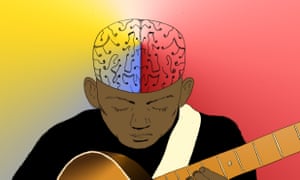 ‘Music probably does something unique. It stimulates the brain in a very powerful way, because of our emotional connection with it.’ Illustration: Sophie Wolfson


